Sleep sounds
Piano music for sleep
Music is the one category here that is not trying to hide. It asks for a little of your attention on purpose, and that is a fair trade for twenty minutes and a bad one for eight hours.
In short
Slow piano gives your attention somewhere pleasant to go while you are letting go of the day, which is why it works so well as a wind-down. Every note also begins with a hammer hitting a string, and those sudden starts are exactly what keeps a light sleeper coming back up, so Tock fades it out rather than running it to your alarm.
- Music beds in Tock
- 9Music beds in TockAmbient, piano, electric piano, singing bowls, cello, choir, music box, kalimba and harp.
- Default fade
- 30 minDefault fadeEvery music bed is a fall-asleep aid. None of them run to your alarm.
- Music sounds with distance
- 0Music sounds with distanceThe control is on 42 of 63, and every one of them is a texture.
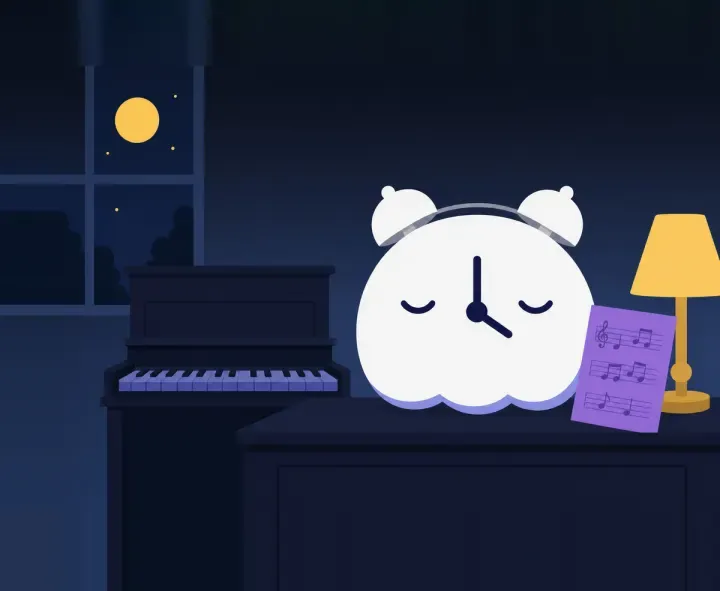
The attack is the whole problem
A piano note is a hammer hitting a string. It goes from silence to full level almost instantly, with a burst of energy across a wide range, and then decays. That first instant is called the attack, and it is the single most attention-grabbing part of any sound.
You want that while you are awake. It is what makes a piano expressive. You do not want it at 4am, when there is nothing else in the room and each note arrives out of silence.
The cello is the music bed that can run all night
If you want music through the night rather than for half an hour, the bowed sounds are the ones to look at. A bowed note has no attack to speak of; it swells in, which is why it is the one music bed in the library with nothing sharp in it.
Singing bowls behave similarly, and Tock's pair are tuned a hair apart so they beat gently against each other. That movement is the physics of two close frequencies rather than anything modulating the sound.
No distance control, on purpose
Far, Near and Close are on 42 of the 63 sounds, and every one of those is a broadband texture. Distance on a texture is a real acoustic fact and a filter reproduces it accurately.
Music is excluded because the physics do not transfer. Moving a piano further away is mostly a reverb, not a filter, and rolling the highs off a piano just sounds like a piano with a blanket over it. Better to leave the control off than to ship one that sounds wrong.
A real performance, not a generator
The piano bed is one of the 22 bundled recordings, a soft neoclassical solo. Phrasing is the part generators lose: a generated piano ends up either too regular to be music or too random to be restful.
The music box in the library goes the other way and is generated, and it winds down as it plays, getting slower and thinner as it goes, so what you are listening to is audibly leaving. A music box holding its tempo until morning would be the most obviously mechanical sound in the app.
Who it suits, and who it does not
Worth trying if
- A wind-down, where a little engagement is the point rather than a side effect
- People who have always fallen asleep to music and are not going to stop now
- Nights when the problem is a busy head rather than a noisy street
- Pairing with a low bed that keeps going after the piano has faded out
Probably skip it if
- Masking anything, since music has holes in it by definition and the holes are musical
- All-night use, because every note is a transient and eight hours is a lot of transients
- Anyone who listens to music actively, who will end up following the harmony rather than sleeping through it
How it behaves once it is running
- It is one of the 22 bundled recordings, so it plays from the app with nothing to fetch.
- You can layer up to four sounds at once and save the result as a mix, so a bed you like is one tap the next night.
- It fades with the sleep timer, and the good-night screen dims itself to near black after twenty seconds so the phone stops being a light source.
What to put underneath it
Four sounds at a time is the limit, and three is usually the sweet spot. These are the pairings that hold up.
- RainfallRain under piano is the pairing that fixes the holes. It fills the space between phrases so the notes stop arriving out of nothing.
- Brown noiseSet brown noise to run all night and the piano to fade at thirty minutes. The music takes you down, the noise keeps the floor up after it has gone.
- FireplaceTwo fall-asleep aids that fade together, and the fire's low roar sits underneath the keys without ever competing for the same frequencies.
Questions people ask
Is it bad to fall asleep to music every night?
For most people it is fine as a wind-down and less good as an all-night habit, because music has structure and structure is something a half-waking brain can pick back up. Tock handles that by fading it after thirty minutes by default. If you want sound all night, put something flat underneath it.
Why does the piano have no Far or Close setting?
Because the control is a filter, and a filter is only an honest simulation of distance on a broadband texture. Applied to a piano it does not sound like a piano across the room, it sounds like a muffled piano in the same place. Every one of the 42 sounds that has the control is noise, weather, water or a room.
What should I use if I want music but sleep lightly?
The cello, which is one long bowed note with no attack in it, or the singing bowls. Both give you tone without the repeated sharp starts that a piano has by nature. Layer either over brown noise if you also need masking.
Related sounds
Nearby textures worth trying on a night this one does not land.
- Late cafeA cafe bed works because a room with people in it reads as safe, and it only keeps working while none of the voices are intelligible. The moment you can pick out a word you start following it, and following language is the opposite of falling asleep, which is why Tock generates the murmur instead of recording a real room.
- FireplaceA fire is a soft broadband roar with sparse, sharp crackles laid on top, and those crackles are transients, precisely the kind of sudden sound a light sleeper surfaces for. It is one of the best wind-down sounds in the library and one of the weakest choices to leave running until morning.
- OceanRolling surf is broadband like rain, but it breathes, cresting and receding on a cycle of about ten seconds, and a lot of people find that slow rise easier to let go of than a flat hush. The cost is that the level moves, so it masks less reliably at the quiet end of every cycle than steady noise does.
- Binaural beatsA binaural beat is something your brain constructs when each ear receives a slightly different tone, so it exists only over headphones and vanishes the moment you use a speaker. The sleep evidence is limited, mixed and mostly short-term, and Tock does not include a binaural beats track, partly because sleeping in headphones brings problems of its own.
Elsewhere on the site
A different corner of the same problem.
- FeaturesSleep soundsTock has 63 fall-asleep sounds. You can play four at a time, save the blend as a mix, and 42 of them carry a Far, Near or Close distance control. 22 are bundled recordings and the rest are generated on the phone as you listen, so they never loop.
- Tock for youTravellers with jet lagYou landed, you are on local time on paper, and your body is running four or eight hours behind. Wide awake at 3am, unusable at 3pm, and it lasts roughly a day per time zone.
- AlternativesTock vs PillowStay with Pillow if you track on your wrist, because it runs on the Watch and Tock does not. Choose Tock if your phone is the only thing on the nightstand and you want the alarm to be the centre of the product rather than a feature of the tracker.
- RoundupsThe best sleep apps for iPhone, sorted by what you're fixingFor iPhone, the best sleep app depends on the problem. Tock is the best all-round pick when the alarm and the morning are what is broken, Apple Health Sleep is the free place to start, Calm is for people who cannot fall asleep, AutoSleep is for Apple Watch owners, Rise is for sleep debt and SnoreLab is for snoring.
- Wake timesWaking up at 4:00amBedtimes by sleep cycle for a 4:00am alarm.
- BedtimesGoing to bed at 12:30amWhere to put the alarm after a 12:30am lights-out.
You cannot just decide to fall asleep
Piano is one of 63 sounds in Tock. Layer four at a time, save the mix, and let the alarm wake you at a lighter moment in the morning.