Features
Your alarm waits for a lighter moment
Most alarms fire on a schedule that has nothing to do with what your body is doing at that second. Smart wake gives Tock half an hour of room to pick a better second.
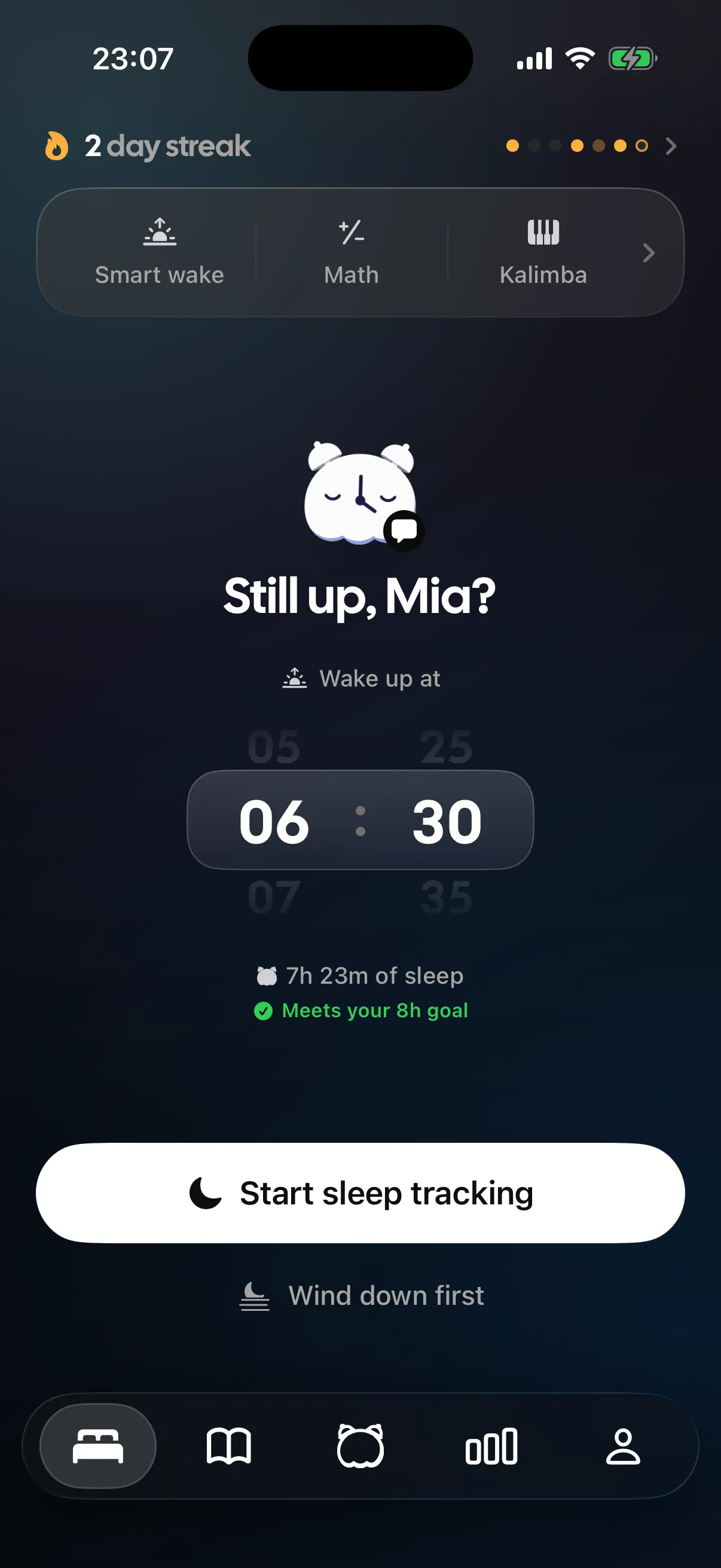
Smart wake is a 30 minute window before your alarm in which Tock watches for a lighter moment in your sleep and rings as soon as it finds one. If it never finds one, your alarm goes off at the exact time you set.
- Window watched before your alarm
- 30 minWindow watched before your alarm
- Channels read at once
- 2Channels read at onceAccelerometer actigraphy plus acoustic
- Time that never moves
- 1Time that never movesYour set alarm is always the fallback
How it actually works
What Tock is watching in the last half hour
Set an alarm for 07:00 and Tock starts paying attention at 06:30. For those 30 minutes it reads two channels at once. The accelerometer measures how much the surface under the phone is moving, which is the same actigraphy idea a sleep clinic uses on a wrist: long stretches of stillness read as deeper sleep, small repeated movements read as lighter sleep. At the same time the microphone listens to the room, and to the shape and rhythm of your breathing.
When both channels agree that you have come close to the surface, Tock rings. That might be 06:47, it might be 06:52, it might not happen at all. If the window runs out and you never look light enough, the alarm fires at 07:00 exactly, the way you set it. The early ring is the bonus. The time you typed is the contract.
- The window is fixed at 30 minutes and always sits before your alarm, never after it
- Motion comes from the phone accelerometer, so the phone has to be in the room and near you
- Nothing in the window can move your alarm later, only earlier
Smart wake is on by default, and you can switch it off per alarm on the nights when you need the exact minute.
Why the same eight hours can feel completely different
Sleep runs in cycles, and each cycle passes through lighter and deeper phases. Being pulled out of a deep phase is what produces that heavy, underwater half hour where you can hear the kettle but cannot form a sentence. Being nudged out of a light phase is closer to how you wake up naturally on a Saturday.
Smart wake cannot give you more sleep. It can change which part of a cycle the alarm lands in, and for a lot of people that turns out to matter more than the extra eleven minutes a snooze buys.
Who gets the most out of it
The people who notice smart wake immediately tend to have a set alarm they cannot move and a morning that starts badly anyway.
- You wake up groggy even after a night that looked long enough on paper
- Your alarm is fixed by a train, a school run or a standup, so the only variable left is how you meet it
- You snooze three times and arrive at the same time you would have anyway, feeling worse
Give it a week before you judge it
On night one Tock has no idea what your sleep looks like, and the window is doing the work from scratch. By the end of a week you have enough nights to compare a smart wake morning with a fixed alarm morning honestly.
- Keep the phone on the nightstand, screen up, on a hard surface rather than buried in bedding
- Plug it in, because the accelerometer and the microphone both run all night
- Leave your alarm time where it is, so the only thing changing is the window
What the morning actually looks like
The alarm arrives as the native iOS full-screen alert, because Tock is built on AlarmKit. The night detail view then shows you when you were asleep, when you woke, and what time the alarm was set for, so you can see the gap between the ring you got and the ring you would have got.
Where it stops
Every feature has an edge. Better you read it here than find it at six in the morning.
- The phone has to be in the room with you. Charging in the kitchen means Tock is watching an empty kitchen.
- On four hours of sleep there is no lighter moment worth finding, and the alarm will simply ring at the time you set.
- A restless partner, a dog on the bed or a phone on a soft mattress all add noise to the motion signal.
- It picks a moment inside 30 minutes. It cannot decide you have had enough sleep and let you keep going.
Questions people ask
Will smart wake ever make me late?
No. The window only ever sits before your alarm, so the earliest it can ring is 30 minutes early and the latest is the exact time you set.
Do I need a watch or a ring for this?
No. Smart wake runs off the phone accelerometer and the phone microphone. If you do wear something that writes to Apple Health, Tock will read it, but it is not required.
What if I want the exact time on a particular morning?
Turn smart wake off for that alarm. It is a switch on the alarm itself, so your other alarms keep the window.
Does it work if my phone is face down or in a case?
Motion still reads fine. The microphone does better with the phone screen up and unblocked, so face down on a soft surface is the worst case for the acoustic channel.
The rest of the app
The parts that sit closest to this one.
- Alarm on silentTock's alarms are registered with iOS through Apple's AlarmKit framework rather than played by the app in the background. That is why they ring with the ringer off, through a Focus, with Tock closed, on the native full-screen alert.
- Sleep trackingSleep tracking in Tock runs on the phone alone. The microphone and the accelerometer stay awake all night, Apple SoundAnalysis labels sounds like snoring, coughing and sleep talking on device, and the clips are saved so you can play them back in the morning.
- Wake-up missionsA wake-up mission is a small task that has to be completed before the alarm will stop. Tock ships 9 of them in 3 families: mind, body and place. The alarm keeps ringing the whole time the task is on screen.
- Sleep scoreThe sleep score is a single number for a night, sitting at the top of that night detail view. Underneath it are the parts that produced it, and across nights the insights cover 21 metrics in 7 groups plus long-run measures like sleep regularity and sleep debt.
Elsewhere on the site
Different corner of the same problem.
- Tock for youSnorersSomeone has told you that you snore, or you have woken yourself up doing it, and you have no idea how loud it really is or whether it is the kind of thing that matters.
- AlternativesTock vs SnoreLabSnoreLab is better if snoring is the only thing you care about and you want a remedy-tracking loop and a score you can show someone. Tock is better if you want the snoring inside a full night, with the alarm, the estimated stages and the score in one app instead of two running overnight.
- RoundupsThe best alarm apps for shift workersFor shift workers the most reliable alarm is still the iPhone Clock app, because it makes no assumptions about your schedule and lets you keep a saved alarm for every shift pattern. Tock is the better pick if you also sleep in the daytime and need something that will not let you turn it off half asleep at 4pm.
- Wake timesWaking up at 5:00amBedtimes by sleep cycle for a 5:00am alarm.
- Wake tonesMusic boxMusic box is Tock's slowest and most nostalgic wake tone, a thin bell-like melody that unwinds instead of alerting. It rings reliably through silent mode because Tock's alarms run on Apple's AlarmKit, but as a tone it is the weakest choice in the set for anyone who genuinely sleeps hard.
- Head to headApple Health Sleep vs AutoSleepIf you wear your Apple Watch to bed and want to know how long you slept, Apple's own tracking is free and already doing it. AutoSleep is for the person who wants that night pulled apart into far more detail than Apple would ever ship.
Your alarm waits for a lighter moment
Smart wake is a 30 minute window before your alarm in which Tock watches for a lighter moment in your sleep and rings as soon as it finds one. If it never finds one, your alarm goes off at the exact time you set.