Features
One number, and the twenty-one that explain it
A score is a useful handle and a terrible explanation. Tock puts the number where you can see it and then spends the rest of the screen showing its working.
In short
The sleep score is a single number for a night, sitting at the top of that night detail view. Underneath it are the parts that produced it, and across nights the insights cover 21 metrics in 7 groups plus long-run measures like sleep regularity and sleep debt.
- Metrics feeding your insights
- 21Metrics feeding your insightsSorted into 7 groups
- Panels on a single night detail view
- 8Panels on a single night detail view
- Stage bands, estimated on phone-only nights
- 4Stage bands, estimated on phone-only nights
How it actually works
One number, and the eight panels under it
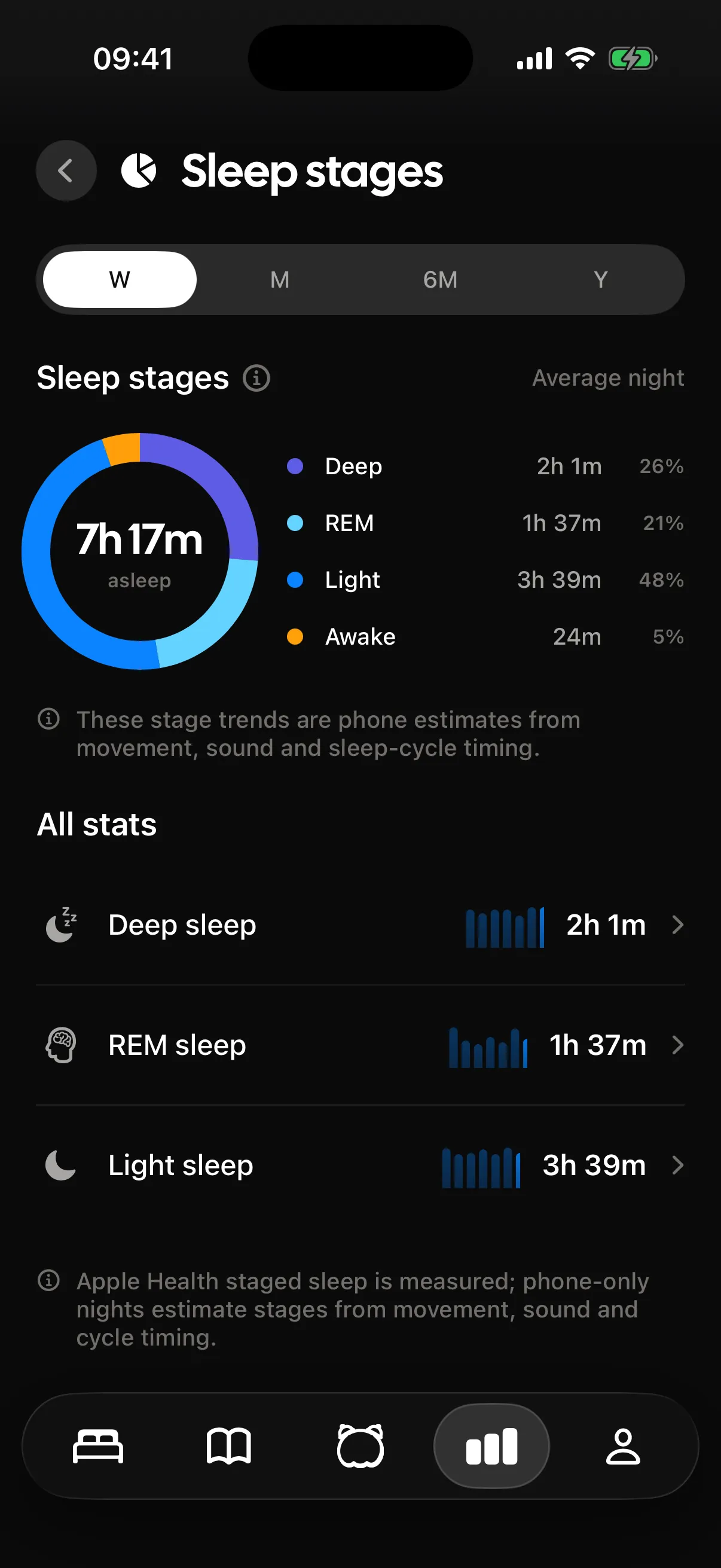
The score sits at the top of the night detail view and is the least interesting thing on that screen. Under it are eight panels for the same night: the stretches you slept in, the stats, the estimated stages, whatever a wearable sent through Apple Health, the sounds you can play back, breathing and room readings, your morning check-in and the tags you added. A score of 71 means very little on its own. A score of 71 with a fragmented stretches chart and a cluster of clips at 03:00 means something specific.
Across nights, insights take over from the single number. There are 21 metrics in 7 groups, plus the measures that only exist over time: your sleep regularity index, your chronotype, how consistent your bedtime actually is, the sleep debt you have accumulated, which factors moved your score, your personal bests, the correlations between the tags you use and the nights that follow, and a calendar heatmap where a bad fortnight is obvious from across the room.
- Score contributors show what pushed the number, so the number is never the end of the answer
- Tag correlations connect a habit you logged to the nights that came after it
- The heatmap is usually where a pattern shows up before you have noticed it
On a phone-only night the stages feeding the picture are estimates from movement, sound and cycle timing. A wearable night through Apple Health brings measured stages instead.
Why a bad score is sometimes the right score
A low number after a genuinely bad night is the app working. The failure mode of sleep scores is people chasing the metric, going to bed anxious about it, and sleeping worse as a result.
Treat the score as a headline for a week rather than a verdict on a morning. Two bad nights in seven is a normal life. Five is a pattern.
The long-run numbers that matter more than last night
Some of the most useful measures in Tock are the ones that cannot exist on a single night, because they are about consistency rather than duration.
- Sleep regularity index, which asks whether you sleep at the same hours, not whether you sleep enough
- Bedtime consistency, which is the one most people fail without noticing
- Sleep debt, which is the running total the weekend is supposed to fix and usually does not
- Chronotype, set from the rMEQ questionnaire during onboarding
Tags are how you find your own causes
The morning check-in and tags are the only part of the night that Tock cannot record for you. Tag the late coffee, the training session, the second glass, the argument, and after a few weeks the correlation view has something honest to work with.
A correlation is a hint about your own habits, not a finding about human sleep.
What to check first when a week goes wrong
Work down from the cheapest explanation to the most involved rather than starting with the interesting one.
- Did your bedtime move, and by how much
- Did the number of stretches go up, meaning the night broke apart rather than got shorter
- Do the clips cluster at a time you did not know about
- Is there a tag that shows up on every bad night and none of the good ones
Where it stops
Every feature has an edge. Better you read it here than find it at six in the morning.
- A phone estimates. The stages behind a phone-only score come from movement, sound and cycle timing, not from measurement.
- One night tells you almost nothing. The score earns its keep across a week or more.
- The score has no idea about your life. A tough night after a flight is not a failure, it is a flight.
- It is not a health assessment and cannot detect a sleep disorder.
Questions people ask
Does Tock measure my deep sleep?
On a phone-only night it estimates your stages from movement, sound and cycle timing, and it says so on the screen. Measured stages come from a wearable through Apple Health.
What is a good sleep score?
Your own average, roughly held. Comparing your number to somebody else says more about your beds than your sleep.
Why did my score drop when I slept the same length?
Usually because the night broke into more stretches, or because bedtime moved. Score contributors will tell you which one it was.
What are insights, as opposed to the score?
21 metrics in 7 groups across your history, plus sleep regularity, chronotype, bedtime consistency, sleep debt, personal bests, tag correlations and a calendar heatmap.
The rest of the app
The parts that sit closest to this one.
- Sleep trackingSleep tracking in Tock runs on the phone alone. The microphone and the accelerometer stay awake all night, Apple SoundAnalysis labels sounds like snoring, coughing and sleep talking on device, and the clips are saved so you can play them back in the morning.
- Apple HealthTock reads Apple Health for sleep, heart rate, resting heart rate, HRV, blood oxygen, respiratory rate and wrist temperature, and shows them on the night they belong to. It can also write its own nights back into Health, but that setting defaults to off.
- Sleep coachThe sleep coach is a chat tab inside Tock that reads your recent nights before it answers. It can quote your score, play back a clip Tock recorded, and navigate the app to change a setting on your behalf. It needs a network connection.
- StreaksTock counts a night toward your streak at 90% of your sleep goal, and it bridges one missed night per week automatically. Milestones sit at 3, 7, 14, 30, 60, 100, 180 and 365 nights, drawn as a moon rather than a flame.
Elsewhere on the site
A different corner of the same problem.
- AlternativesTock vs Headspace SleepHeadspace Sleep is the better choice if you want a voice walking you through a wind-down inside a proper course structure. Tock is the choice if you want the night measured from the phone and an alarm that moves into a lighter moment. Neither one covers the other.
- RoundupsThe best free alarm apps for iPhoneThe best free alarm app for iPhone is the Clock app that came with it. It is free forever, it rings through silent mode and a Focus, and it has never failed. Alarmy is the best free option if you need an alarm that is hard to turn off. Tock is not free and is listed last for that reason.
- Wake timesWaking up at 6:00amBedtimes by sleep cycle for a 6:00am alarm.
- BedtimesGoing to bed at 8:00pmWhere to put the alarm after a 8:00pm lights-out.
- Sleep by ageHow much sleep school-age children needThe American Academy of Sleep Medicine recommends that children aged 6 to 12 years sleep 9 to 12 hours per 24 hours on a regular basis. By this age sleep has consolidated into the night, so the figure is effectively a nightly one and the bedtime has to be counted backwards from the school run.
- NapsThe 60 minute napA 60 minute nap includes a substantial amount of slow wave sleep, which is useful for recovery and for some kinds of memory, and it usually ends before the cycle completes. That means the benefit is real and the wake-up is often groggy, so it suits situations where the hour afterwards is flexible.
One number, and the twenty-one that explain it
The sleep score is a single number for a night, sitting at the top of that night detail view. Underneath it are the parts that produced it, and across nights the insights cover 21 metrics in 7 groups plus long-run measures like sleep regularity and sleep debt.