Features
In the morning you get to hear what the room actually did
Nobody believes they snore. The argument ends the first time you press play on 02:08 and hear yourself.
In short
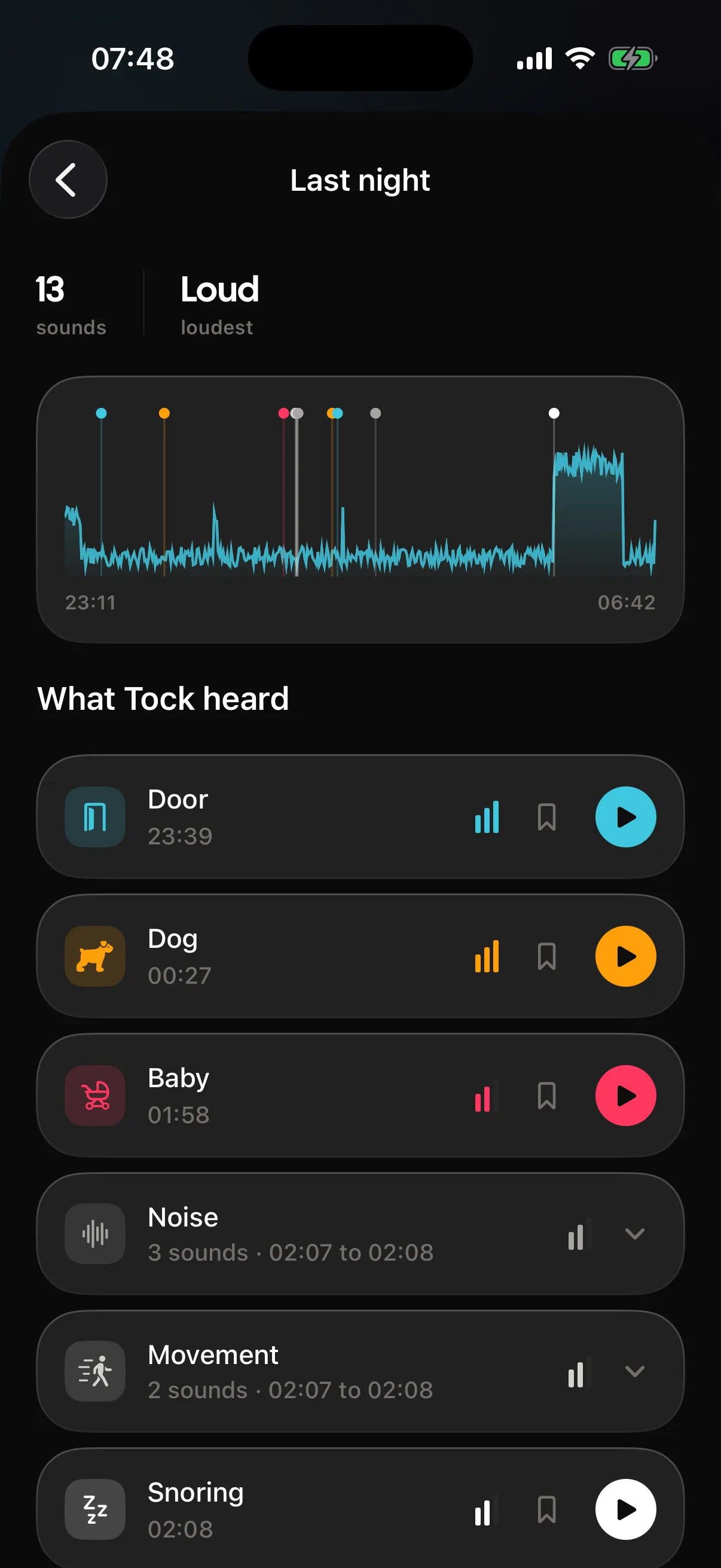
Tock keeps short audio clips of the things it hears in the night and pins each one to the minute it happened. Snoring, coughing and sleep talking are labelled by name, and every clip has a play button in the morning.
- Sleep sounds labelled by name
- 3Sleep sounds labelled by nameSnoring, coughing and sleep talking
- Sensors awake all night
- 2Sensors awake all nightMicrophone plus accelerometer
- Tap to play the 02:08 spike back
- 1Tap to play the 02:08 spike back
How it actually works
How a snore becomes a clip you can press play on
The microphone runs all night and feeds Apple SoundAnalysis, the on-device sound classifier built into iOS. It does not save eight hours of audio and hand you a file to scrub through. It watches the stream, and when it is confident about what it just heard, it keeps that piece and lets the rest go. Snoring, coughing and sleep talking are labelled by name.
The classification happens on the phone. In the morning the clips sit on the night detail view, pinned to the minute they happened, so the spike at 02:08 in the waveform has the 02:08 audio underneath it. You press play and hear the room. Most people find the first morning uncomfortable and the second morning genuinely useful, because by then you are listening for a pattern rather than for yourself.
- Clips are attached to the timeline, not dumped in a folder to sort out later
- A loudest-sound summary tells you how the night ranked before you play anything
- Anything audible in the room lands in the same microphone, including a partner, a baby or a dog
This can tell you that you snored and roughly when. It cannot tell you why, and it is not a screen for sleep apnoea.
Reading a night before you press anything
The waveform across the top is the whole night at a glance, with a marker wherever Tock labelled something. Long flat stretches are the boring good part. Clusters are where a night came apart, and that is usually the only place worth listening.
Taking the clips to a conversation
Two conversations get easier when you have audio. The one with whoever shares your bed, because "you were loud" becomes a timestamp. And the one with a doctor, because "I think I snore" becomes a pattern you can describe with times attached.
Neither of those makes Tock a diagnostic tool. It just means you turn up with something better than a feeling.
Tock is not a medical device and cannot detect a sleep disorder. Bring the pattern to a professional, not a conclusion.
What to change first if the clips are bad reading
A week of loud nights is worth acting on one variable at a time, and the usual suspects are boring.
- Sleeping position, since back sleeping is the easiest thing to test
- Alcohol within a few hours of bed
- Room air, which is why the breathing and room readings sit on the same screen
Where it stops
Every feature has an edge. Better you read it here than find it at six in the morning.
- The microphone cannot tell whose snore it heard. If somebody shares the bed, some of the audio is theirs.
- Clips are the room, not just you. Treat playback as shared audio rather than a private diary.
- Snoring is not sleep apnoea and Tock cannot tell the difference. Nothing here diagnoses anything.
- A phone under a pillow or face down on soft bedding records badly. Nightstand, screen up, is the setup that works.
Questions people ask
Does Tock upload my audio?
Classification runs on the phone through Apple SoundAnalysis. Tock keeps short clips of what it labelled and drops the rest of the stream.
Will it pick up my partner too?
Yes. One microphone hears one room, and it cannot separate two sleepers. That is worth agreeing on before you start recording.
Can this tell me if I have sleep apnoea?
No. Tock is not a medical device and does not diagnose anything. If your nights worry you, take the pattern to a doctor.
How long is each clip?
Short. Tock keeps the piece around the sound it labelled rather than the whole night, which is why a week of nights does not fill your phone.
The rest of the app
The parts that sit closest to this one.
- Sleep trackingSleep tracking in Tock runs on the phone alone. The microphone and the accelerometer stay awake all night, Apple SoundAnalysis labels sounds like snoring, coughing and sleep talking on device, and the clips are saved so you can play them back in the morning.
- Sleep scoreThe sleep score is a single number for a night, sitting at the top of that night detail view. Underneath it are the parts that produced it, and across nights the insights cover 21 metrics in 7 groups plus long-run measures like sleep regularity and sleep debt.
- Sleep coachThe sleep coach is a chat tab inside Tock that reads your recent nights before it answers. It can quote your score, play back a clip Tock recorded, and navigate the app to change a setting on your behalf. It needs a network connection.
- Sleep soundsTock has 63 fall-asleep sounds. You can play four at a time, save the blend as a mix, and 42 of them carry a Far, Near or Close distance control. 22 are bundled recordings and the rest are generated on the phone as you listen, so they never loop.
Elsewhere on the site
A different corner of the same problem.
- Head to headAutoSleep vs SleepScoreIf an Apple Watch is already on your wrist at night, AutoSleep is the better tracker and it asks nothing of you. If you sleep bare-wristed and want to keep it that way, SleepScore is the only one of the two that can track you at all.
- Sleep soundsPink noisePink noise drops about 3 dB with every octave, which works out to equal energy in every octave and is close to how a lot of natural sound is distributed, from rain to wind in trees to tyres on a wet road. It reads as a balanced hush rather than a hiss or a rumble, which is why it is usually the right thing to try before you commit to either extreme.
- Tock for youNight owlsYou are wide awake at 1am and useless at 7am, and every piece of advice you have ever read starts with going to bed earlier, which you have done, repeatedly, while staring at the ceiling.
- AlternativesTock vs Headspace SleepHeadspace Sleep is the better choice if you want a voice walking you through a wind-down inside a proper course structure. Tock is the choice if you want the night measured from the phone and an alarm that moves into a lighter moment. Neither one covers the other.
- RoundupsThe best smart alarm apps, and what smart should meanTock is the best smart alarm app on iPhone. It watches the 30 minutes before your alarm using two signals, movement and sound, rings early if it catches a lighter moment, and falls back to your set time no matter what. Sleep Cycle is the long-established alternative, and Pillow is the better pick if you already wear an Apple Watch to bed.
- Wake timesWaking up at 9:00amBedtimes by sleep cycle for a 9:00am alarm.
In the morning you get to hear what the room actually did
Tock keeps short audio clips of the things it hears in the night and pins each one to the minute it happened. Snoring, coughing and sleep talking are labelled by name, and every clip has a play button in the morning.